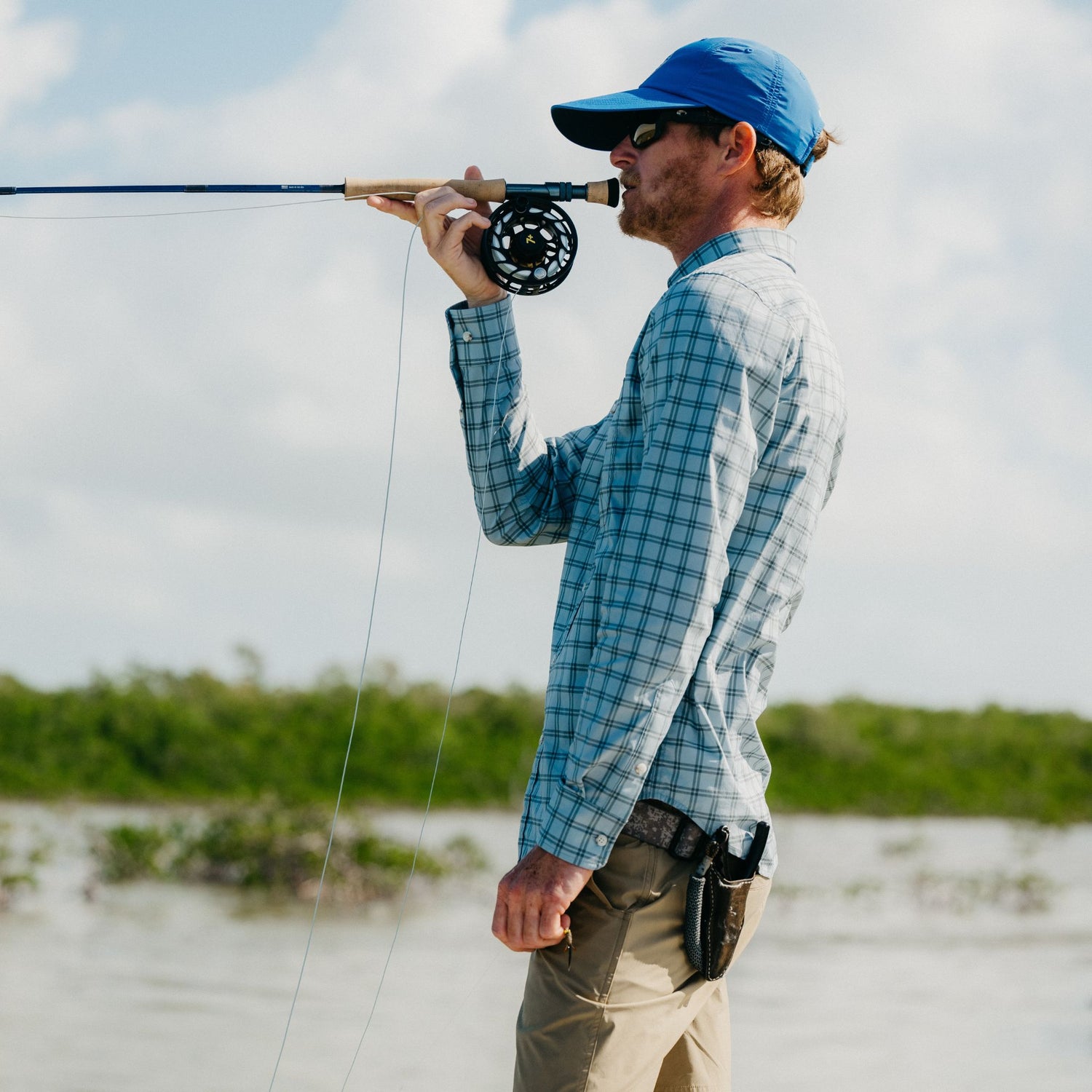
In the early months of 1996, after a long period of immobility, I frequently found myself on the fishing pier at the Savannah Bluff Lock and Dam in Augusta, Ga. I was thrilled to be looking at water again and holding a fishing pole. At the time, the pier was a good place to relax, to let the mind wander through life’s confusions, and to fish for whatever swam the Savannah River. On the pier, sitting on my five-gallon bucket, I had a bird’s eye view of the clouds and dam above me, and the meandering path of the river below as it headed toward the ocean.
The Savannah Bluff Lock and Dam is the first blockage for anadromous fish coming up the Savannah River from the Atlantic Ocean. These migrating fish mill about in a large circle below the dam and the fishing is good for stripers, shad, and tasty yellow perch. On weekdays the pier is always filled with men without access to boat or pond. They come to reconnect with nature. Very often they are men who have been dealt a bad hand emotionally, financially, or physically, so I fit right in.
The air was still cold as I drove to the lock and dam. I turned on the heater. It was the transition time, when the coziness of winter fires had long since lost their novelty but there were no buds on the trees signaling the entrance of spring. It was a time perfect for a man moving from dormancy to a state of productivity. I looked forward to watching the trees turn green, white dogwoods, red azaleas, and all the new life infused into creation.
Fog sat heavy in the low-lying areas so I didn’t expect much that day. I arrived late and parked next to the ramp leading out to the pier. The sun was tardy burning the fog off the water and I couldn’t see the fishermen on the pier, but I knew they were there. They were always there. There was no point in expending what little energy I had unnecessarily, so I sat in my truck drinking coffee and waited for the fog to lift to see if any spots were open.
Just as the pier came into focus, a fisherman came walking down the ramp, heading for his car, leaving a spot open. Grabbing my gear and five-gallon bucket, I rushed out to greet him. He was a friend from previous days on the pier and I quickly found out that the yellow perch were biting. As he left he said, “Whatever you do, don’t fish next to that tall Korean dude, he’s jinxed.”
On the pier, I saw two spots open, one on either side of the tall Korean man. Never giving attention to superstitions, I disregarded the previous conversation and politely asked if I could set up next to him. He peered at me through thick glasses and welcomed me in broken English.
The mist was still thick on the tail race as I set my rigs out, but I was struck by the many hues of gray in the concrete of the dam and the skeletons of leafless trees along the bank. With my rigs set, I flipped my five-gallon bucket upside down and sat on it. I watched my line carefully to make sure my sinkers were heavy enough in the currents that caused my rod tips to sway gently back and forth. Sometimes the current gave a strong tug on the tip of the pole, making me think I was getting a nibble. It kept my expectations up. I watched the Korean’s poles too and was vexed thinking of what my friend had said about him.
It was protocol for pier fishermen to sit on their buckets and take in the surrounding beauty of the Savannah River and dream of the big fish that would come their way. Afterthey caught their first fish of the day, they walked down the pier to the water spigot showing off their catch regardless of size. All present nodded in silent appreciation of one of life’s simplest and most cherished victories, catching a fish.
I could tell my Korean neighbor was light on his sinkers as his lines began to drift closer to mine. Getting lines crossed was not uncommon with men fishing so close together and with currents constantly changing speed and direction.The trick was knowing when to reel yours in, adjust your weights, and reset before getting tangled up with your neighbor. I watched as his line drifted ever closer to mine. Within minutes we were tangled. I reeled in, untangled the mess, and reset my line. I noticed it took him forever to reel in his line. His reel looked to be an antediluvian contraption and sounded much like a coffee grinder. It was an unusual make of reel; one I had never seen before. I was a little perturbed he had not been paying attention to his line and said, “You probably need a little heavier weight,” and thought about the possibility he was jinxed. Suddenly, I heard a bell ringing and one of his poles was bending viciously in its holder. It was the first time I had ever seen a man fish with bells on his rod.
He had three poles set out and he grabbed the wrong one. The one bending, the one with the bell ringing, was still in its holder. He picked up the next. He was wrong once again. As the pole with the fish bent double again, I thought, “By the time he gets to the right pole his fish will be gone.” And sure enough, by the time he got to the right pole, his fish was gone and I watched his look of excitement turn to bitter disappointment. It took him forever to get his line in and re-bait his hook but within fifteen minutes he had another strike. This time it was the first pole he picked. He jerked it out of its holder and set the hook. I observed him more closely as he fought his little perch. Not only did he have glasses as thick as the fog, his khaki outfit was stained and threadbare. Threads dangled from his shirt sleeves where there should have been cuffs with buttons, his pants much the same. He wore a rope for a belt and his bare toes protruded from shoes missing parts of the soles. I felt pity and aggravation at the same time.
The way that little perch was taking line you would have thought it was a forty-pound striper. It was exasperating just to watch. Five minutes later he was still reeling. I finally said, “May I try?” He handed me his rig and I started reeling. With every gain, the fish took more line. I found the brake adjustment, but it didn’t work. And the gears driving the bail only caught intermittently. The tall Korean looked at me, perplexed and helpless. I said, “We have to hand haul.”
I set his pole down against the railing, grabbed the line, and began pulling his little fish in, hand over hand. “It’s easy, you try.” I held the line up for him to take and he reached for it several times. Each time he grabbed air. It was then I realized the tall Korean was not jinxed at all, he was just blind as a bat. I checked all his poles and they were all the same, none of them worked. I remember thinking how horrible it would be to go through life seeing only general shapes and a vague outline of the world around you, never seeing the details. How could he ever get his line through the eye of a fishing hook? How could he ever hold a job? There were so many questions running through my mind.
I handed him one of my rigs, and said, “Here, put your bell on this one and see how it works. And maybe just use one pole.” The rest of the day whenever he heard the bell ringing, he knew exactly which one to grab. He ended the day with a mess of fish. Leaving, he smiled at me and said in broken English, “Wife be very happy.” She was waiting in their car all that time, watching her man provide, and no doubt happy they would have a feast that night. And I had spent most of my day watching him and helping whenever I could. Enjoying his success, I handed him my pole, “Here, take this rig home with you, and hang the other ones on your wall.”
It would have been easy for me to go home that day feeling good about myself for having helped a neighbor. But I learned a lot from a jinxed man. I saw that my judgments sometimes prevent me from seeing beyond appearances; that many men face battles I am never aware of. I learned not to feel ingratitude for the cards life has dealt me. And now I always remember that sooner or later the sun shines and burns the fog away.
About the Author
R. Van Hudson is retired from Engineering & Construction and lives in Buford, GA. He is an avid outdoorsman who grew up in the fields and on the lakes of Alabama and Georgia. He spends his time writing memories for his grandchildren.